How to Choose Affiliate Programs Without Chasing the Wrong Payout
A practical decision guide for judging affiliate programs by audience fit, commission quality, cookie window, approval path, payout risk, and content strategy.
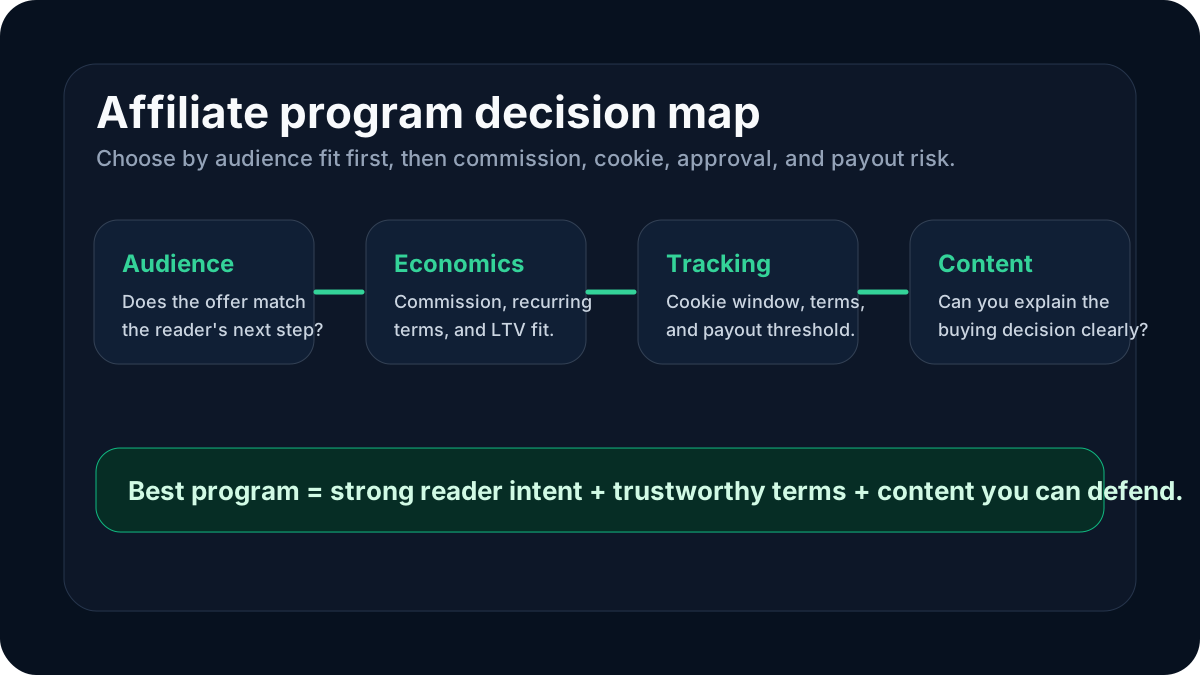
- Start with reader intent before you compare commission rates.
- Treat payout, cookie duration, approval rules, and refund risk as one system.
- Choose programs you can explain honestly in repeatable content, not just programs with impressive headline numbers.
Choosing affiliate programs is not the same as collecting affiliate links. A good program has to fit the reader, the content, the payout model, and the level of proof you can responsibly provide.
Most beginners compare the visible numbers first: commission rate, cookie window, payout threshold, and maybe whether the program is recurring. Those details matter, but they are not enough. A 50% recurring program can still be weak if your audience is not close to buying. A smaller one-time payout can be stronger if the reader has urgent intent and the product solves a clear problem.
Start with the reader’s next step
The first question is simple: what is the reader trying to do next?
A person reading about ecommerce setup may be ready to compare store builders, payment tools, hosting, themes, or fulfillment apps. A person reading a general productivity article may not be ready to sign up for a paid workspace tool. The same affiliate program can perform very differently depending on where the reader is in the decision path.
Before you judge a program, write one sentence:
This program helps my reader do
___after they have already decided___.
If you cannot complete that sentence clearly, the program may be too far from your current audience.
Commission rate is only one part of the economics
Commission rate looks objective, but it can be misleading. You need to understand the full earning path:
- Is the commission one-time, recurring, tiered, or hybrid?
- Does the program pay on trials, first payments, renewals, upgrades, or only qualified purchases?
- Is there a minimum payout threshold?
- Are refunds, chargebacks, or cancellations common in the category?
- Does the offer require a sales call, demo, or manual approval?
For example, a lower headline rate can still win if the product has strong demand and a simple checkout path. A higher rate can disappoint if the buyer needs months of education before converting.
Cookie duration matters most when the buying journey is slow
A long cookie window helps when the buyer needs time to compare, ask a team, test a trial, or wait for budget approval. It matters less when the product is cheap and the decision is immediate.
Look at cookie duration together with the content type. Review pages, comparison pages, tutorials, and pricing explainers often benefit from longer windows because the reader may return later. Coupon-only traffic may convert faster, but it can also be more fragile if the brand changes terms.
Approval difficulty changes your content plan
Some programs approve almost anyone. Others want an established site, clear traffic sources, brand-safe content, or a specific audience. Do not build a full campaign around a program until you understand the approval path.
If the program is selective, prepare proof before applying: relevant articles, a real audience description, traffic channels, and a plain explanation of how you will promote the brand. You do not need to exaggerate. You need to look intentional.
Choose programs you can explain honestly
The best affiliate pages reduce uncertainty. That means your content should help readers understand who the product fits, where it may be too much, what plan or setup to check, and when a simpler alternative may be enough.
A program is a poor fit when the only content angle you can think of is “click my link.” A stronger program gives you multiple honest angles: beginner guide, setup tutorial, comparison, checklist, pricing explainer, workflow example, and alternatives map.
A simple scoring method
Use this quick scoring pass before adding a program to your core stack:
- Audience fit: Is this clearly useful to your existing readers?
- Buyer intent: Are readers close enough to a decision?
- Commission quality: Does the payout model match the effort required?
- Tracking clarity: Are cookie, attribution, and payout rules understandable?
- Content depth: Can you create several useful pages without repeating yourself?
- Trust risk: Are there refund, compliance, or claim risks you need to manage?
If a program scores weak on audience fit, do not rescue it with a high commission. It will probably become thin content.
Where to go next
After you choose a few candidates, compare them side by side. Then build one focused content path for each program: a guide for early awareness, a comparison for decision-stage readers, and a program page or review for final evaluation.
The goal is not to promote every possible offer. The goal is to build a small group of offers your audience can trust you to explain.

Steven Doan
Founder & Affiliate Program Researcher
Steven Doan researches affiliate programs, payout models, approval paths, and publisher fit for AffiBest.
Frequently asked questions
Should I choose the affiliate program with the highest commission? +
Not automatically. A high commission can be attractive, but it only matters if your audience is likely to buy, the tracking terms are clear, and you can create content that moves readers toward a real decision.
How many affiliate programs should a new site promote? +
For a focused niche site, a small shortlist is usually better than dozens of unrelated offers. Start with a few programs that match your best content angles, then expand after you see which pages attract qualified readers.
What is the safest first program to choose? +
The safest first choice is usually not the highest-paying program. It is the program your audience already needs, understands, and can evaluate through your content without exaggerated claims.