
NEURONwriter
Use semantic recommendations to boost your SEO and plan high-ranking content
$109.00
Product Pillar (Entity Core)
NeuronWriter
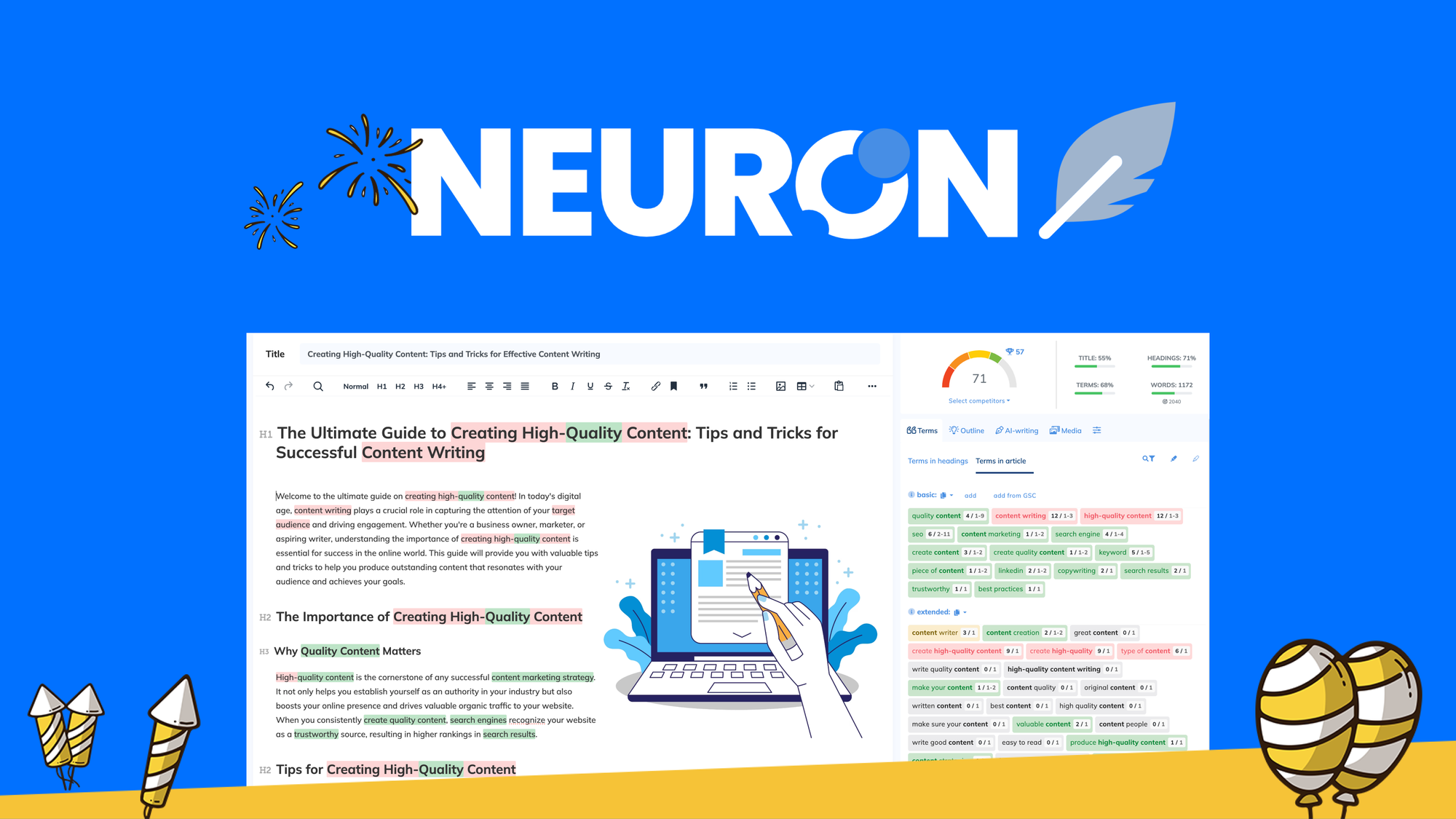
NeuronWriter is an AI-assisted SEO writing and content optimization tool that helps you plan, write, and improve pages using SERP-informed suggestions—without turning your content into bland "AI mush."
Try NeuronWriter (Best for SERP-driven content optimization)
If your biggest bottleneck is "I know what to write, but I'm not sure what Google expects," NeuronWriter is built for that exact moment.
- Best for: affiliate sites, niche publishers, small content teams
- Focus: content editor + NLP terms + competitor insights
- Workflow: brief → outline → optimize → publish
Tip: I recommend starting with one content cluster and measuring lift before scaling.
Refreshing & optimizing existing pages, writing SEO-first content briefs
Hands-off "autoblog" publishing, teams needing strict enterprise workflows
Most value when you treat it like a coach, not a writer.
What NeuronWriter is (and what it isn't)
NeuronWriter sits in the "content optimization" lane: you bring a topic and a page goal, and it helps you shape the page so it aligns with what's already working in search.
Think of it as a structured editor that nudges you toward better coverage—keywords, headings, entities, and topical completeness—based on the SERP landscape.
Here's the line I wish someone drew for me earlier: NeuronWriter is not a magic "rank my article" button. It's closer to a coach that keeps you honest.
If you're willing to write like a human and let the tool guide your coverage, you'll get value. If you want it to publish for you while you sleep, you'll be disappointed.
The reason I like placing this as a Product Pillar Page is simple: people searching "NeuronWriter" often aren't only asking "Is it good?"
They're asking: "Is this the right tool for my kind of site, my workflow, my budget—and what should I do with it after I buy it?"
This page answers that whole question, end to end.
Who NeuronWriter is for (and who should skip it)
It's a strong fit if you are…
- Affiliate site builders who need repeatable "brief → outline → publish" routines.
- Niche publishers trying to compete without hiring a full SEO team.
- Small content teams who want consistency across writers.
- Editors who spend too long giving the same feedback: "cover this angle, add examples, explain the 'why.'"
You should probably skip (or delay) if you are…
- Brand-first writers who refuse to align with search intent at all (you'll fight the tool daily).
- Enterprise teams that need deep approvals, permissions, and rigid workflow governance.
- Anyone chasing pure automation—NeuronWriter helps you write better, not write less.
My honest bias: if you're in the "I'm not making money yet and I'm tired" phase, you need tools that create momentum, not tools that create more settings.
NeuronWriter is momentum-friendly when you use it to standardize what "good enough to publish" means.
Key features that actually matter (in real publishing)
1) SERP-informed content editor
This is the core: NeuronWriter compares your draft against what's ranking and suggests terms, topics, and structure improvements.
I treat this as a "coverage checklist" so I don't publish a page that accidentally skips the one subsection Google expects.
2) Topic & entity guidance (the anti-thin-content guardrail)
If you've ever published a page that felt "fine" but never moved, sometimes the problem is not your writing—it's missing entities and concepts.
NeuronWriter's guidance helps reduce that blind spot.
3) Competitor-driven inspiration without copy-paste
I'm careful here: the goal is not to imitate. The goal is to notice patterns:
what questions appear repeatedly, which comparisons people care about, what objections show up in the SERP.
That's how your page becomes more complete and more useful.
4) Briefing and outlining (where the ROI hides)
Most people evaluate these tools by "how good is the writing." I evaluate by "how fast do I get a usable outline."
When you publish at scale, outlines are the real bottleneck. NeuronWriter helps you create an outline that matches intent before you waste hours drafting.
5) Refresh workflow support
For affiliate sites especially, content refreshes can outperform brand-new posts (less competition, existing links, existing crawl history).
NeuronWriter makes refreshing more systematic: re-check SERP patterns, add missing angles, improve clarity, republish.
NeuronWriter pricing: what you're really paying for
Pricing changes over time, so instead of pretending a number is permanent, I'm going to explain what the pricing means.
In tools like this, you're paying for three things:
- How many content projects you can run (and how many pages you can optimize each month).
- How deep the SERP analysis is (and how much guidance you get per page).
- How smoothly it fits your publishing cadence (solo builder vs. small team).
My rule: if you publish fewer than 4 serious pages a month, you may not extract full value yet.
If you publish 8–20 pages a month across clusters (reviews, comparisons, workflows), the tool can pay for itself by improving hit rate and reducing rewrites.
Want the best price?
If you're buying anyway, use a deal page so you don't leave money on the table.
My realistic workflow (how I'd use NeuronWriter on an affiliate site)
I'll be honest: the first time I tried SEO writing tools years ago, I used them like a student trying to "get an A."
I obsessively chased a perfect score and ended up with stiff, repetitive paragraphs. The page looked optimized, but it read like it hated the reader.
The better mental model is: use NeuronWriter to build a brief and a coverage map, then write like a person.
Here's the workflow that stays fast and keeps your voice intact.
Step 1: Pick the page goal and intent
- Commercial: "best AI SEO tool for affiliate sites"
- Comparative: "NeuronWriter vs Surfer"
- Informational: "content optimization workflow"
Step 2: Build the outline first (don't draft yet)
I create headings based on intent, then use NeuronWriter's guidance to check if my outline covers the angles the SERP rewards.
This is where you save time: fixing structure early is cheap; fixing it after 2,000 words is pain.
Step 3: Write the "human sections" intentionally
I always add at least two sections that are hard for generic AI to fake:
a "what surprised me" section and a "what I'd do differently" section.
Even if your site is new, you can write these from honest constraints: time, budget, learning curve, trade-offs.
Step 4: Optimize lightly (not obsessively)
I optimize until:
(1) the page covers the expected topics,
(2) the headings match user questions,
(3) the wording doesn't feel spammy.
Then I stop.
Step 5: Publish + internal link the silo
This is where your structure becomes a weapon. I publish the pillar, then immediately connect the supporting pages:
review, coupon, workflows, and comparisons. That network is what builds "entity authority" around NeuronWriter.
Pros & cons (reviewer-realist mode)
What I like
- Outline-first friendliness: helps you avoid drafting the wrong page.
- Coverage guidance: reduces "thin content by accident."
- Refresh workflow support: practical for sites that already have posts.
- Good fit for niche publishers: you don't need enterprise ops to benefit.
What I don't love
- Scoring temptation: chasing perfect scores can ruin readability.
- Tool fatigue risk: if you buy too early, it becomes "another dashboard."
- Not a strategy replacement: you still need topics, intent mapping, and links.
If you're currently burnt out because you've worked 6 months with zero revenue: I get it.
The fix usually isn't "work harder." It's "build a system that produces fewer but stronger pages, then ship consistently."
NeuronWriter can support that—if you keep the workflow simple.
Alternatives (Surfer, Frase) and when to choose each
NeuronWriter isn't the only option in this category. The real question is: what kind of publishing system are you building?
Here's a practical way to decide.
Choose NeuronWriter if…
- You want a pragmatic optimizer for niche publishing and affiliate clusters.
- You prioritize "brief + outline + optimize" more than heavy team management.
- You want a strong value tool that can scale with you.
Choose Surfer if…
- You want a more established ecosystem and broader workflow integration (often used by bigger teams).
- You're comfortable paying more for polish and team features.
Choose Frase if…
- You care a lot about research, question extraction, and drafting assistance in one place.
- Your workflow starts with "research-first" rather than "optimize-first."
If you want the cleanest funnel structure, I recommend reading the head-to-head pages inside this silo:
NeuronWriter vs Surfer and
NeuronWriter vs Frase.
Those pages handle objections much better than a single "alternatives" section ever can.
NeuronWriter FAQ
Is NeuronWriter good for beginners?
Yes—if you use it to create outlines and coverage checklists. Beginners often improve faster because the tool forces you to think in search intent.
Will it make my content sound AI-generated?
Only if you let it. The tool can push you toward repetitive phrasing if you chase scores.
Write your examples and opinions first, then use optimization lightly.
Can NeuronWriter replace an SEO strategy?
No. It helps execute strategy (better pages), but you still need topic selection, internal linking, and publishing cadence.
Should I use it for new posts or updates?
Both, but updates are often faster ROI: you already have a page, it's already indexed, and small improvements can move rankings sooner.


There are no reviews yet.