
 admin
admin 
If you’re researching Frase pricing in 2026, you’re probably not asking “what’s the cheapest plan?” You’re asking a more practical question: which plan will I actually use enough to justify paying for it?
That distinction matters because most SEO tools don’t fail due to lack of features. They fail because they don’t get used. The plan you choose should match your workflow volume (how often you publish or refresh) and your operating model (solo vs team vs agency).
One observed reality: content teams are being asked to publish more, update more, and prove performance faster—often without adding headcount. Pricing only feels “fair” when the tool genuinely removes friction every week.
Frase pricing in 2026: the plan structure (what’s actually different between tiers)
Frase’s pricing is structured around a simple idea: every tier includes the full platform, and the tiers mainly change your volume (how much you can produce/track/audit) and team scale (seats, domains, governance depth).
As of early 2026, the core tiers are:
- Starter (solo creators)
- Professional (most teams start here)
- Scale (agencies and high-volume teams)
- Enterprise (custom infrastructure, security, and volume)
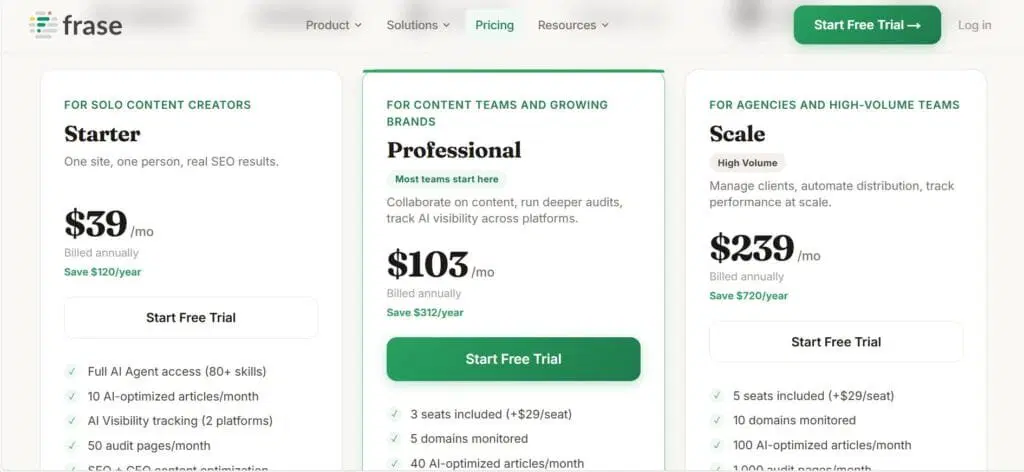
There’s also a meaningful pricing choice that sits above plan names: monthly vs annual billing. Annual billing typically saves money, but only makes sense when you’re confident you’ll use the tool consistently.
My stance: picking a tier by “what looks affordable” is how you end up underpowered (and frustrated) or overbought (and resentful). Pick by workflow first.
A quick plan snapshot (so you can self-select fast)
Instead of copying a big pricing table with no interpretation, here’s the practical view: what each tier is designed to support.
| Plan | Best for | What increases vs the tier below | Where it can be the wrong buy |
|---|---|---|---|
| Starter | Solo creator running one site and publishing consistently | Entry volume for articles, audits, and AI visibility tracking | If you publish in bursts, or you need real collaboration (multiple seats/domains) |
| Professional | Small content teams and growing brands | More volume + multiple seats/domains + stronger governance capacity | If you don’t have a team process yet (it can become “nice to have” instead of essential) |
| Scale | Agencies, multi-site operators, high production volume | High volume across articles/audits/tracking + larger team scale | If you’re not truly high-volume—this is where overbuying gets expensive |
| Enterprise | Large orgs needing security/compliance and custom volume | SSO, white-label, SLA, dedicated support, custom limits | If you mainly need “more articles,” not enterprise infrastructure |
If you’re still unsure whether Frase fits your workflow at all (not just which tier), start with the broader evaluation: see the full Frase review for real content workflows.
What changes between Frase tiers (the few levers that matter)
Most plan comparisons get noisy because they list everything. The truth is, the purchase decision usually hinges on 5–6 levers.
1) Content volume included (articles/documents per month)
If you publish weekly, a lower tier might be fine. If you publish daily (or refresh aggressively), you’ll feel constrained fast. This is one of the most common “we picked the wrong plan” drivers.
2) Site audit capacity
Audit allowances matter if you’re serious about maintenance: decays, quick wins, technical hygiene, and prioritizing updates. If you never run audits, don’t pay for a tier just because audits sound impressive.
3) AI visibility tracking / prompts
This is valuable for some teams, premature for others. If you’re not actively measuring AI visibility (and doing anything with the data), higher limits won’t add ROI.
4) Team seats
Seats aren’t just “logins.” They’re how you scale a workflow across writers, editors, strategists, and stakeholders. If multiple people need to work in the tool, don’t force a solo plan to behave like a team plan.
5) Domains monitored
If you run multiple sites or manage clients, domain allowances become the real limiter. This is where agency-style tiers start to make sense.
6) Governance depth (brand voices, reference docs)
If you’re training AI outputs to match brand standards, governance capacity matters. If you’re not using those features, don’t pay extra for them.
The expectation shift for many buyers: the “best plan” isn’t the one with more features. It’s the one that matches your actual production rhythm.
Which Frase plan should you choose? (decision rules by buyer type)
Here are clean criteria you can apply without overthinking it.
Choose Starter if you’re a solo operator and you publish consistently
- You’re managing one site (or one main domain) and want a repeatable research → brief → optimize workflow.
- You don’t need multi-user collaboration inside Frase.
- Your biggest bottleneck is research and structure, not team coordination.
When Starter is the wrong fit: you’re coordinating multiple writers/editors, or you’re managing multiple domains and need true collaboration.
Choose Professional if you’re a small team (or a solo operator acting like one)
- You have multiple people touching content (strategy, writing, editing, approvals).
- You need more throughput and governance capacity.
- You want the workflow to be consistent across content pieces, not reinvented each time.
When Professional feels overpriced: you don’t have a repeatable process yet. Buying a “team” tier won’t create a workflow by itself.
Choose Scale if you’re high-volume or running an agency model
- You’re shipping lots of content monthly (or running multiple sites/clients).
- Audit volume and monitoring depth matter to you.
- You want fewer tool handoffs and more standardized production.
When Scale is overkill: you don’t actually have high volume. This is the tier people buy for “future growth” and then regret.
Consider Enterprise only if you need enterprise infrastructure
Enterprise plans make sense when your constraints are security, compliance, onboarding, SLAs, or custom monitoring needs—not just “we want more content.”
Frase free trial: how to use it to pick a plan (without wasting the week)

Frase offers a free trial (typically 7 days) and you can often start without a credit card. The important detail: trials usually include a limited bundle of credits/allowances so you can test major workflows rather than running full-scale production.
Here’s the simplest trial plan I recommend:
Day 1: test briefing speed on a real keyword
- Pick a keyword you genuinely plan to publish this month.
- Build a brief and outline.
- Ask: did this reduce research time, or did it just produce a generic outline?
Day 2: test editing + optimization restraint
- Draft a section (with or without AI).
- Use optimization guidance as a checklist, not a target score.
- Ask: did the content become clearer and more complete, or just longer?
Day 3: test a refresh workflow
- Import an existing page that’s slipping (or feels thin).
- Use the tool to identify missing sections and update opportunities.
- Ask: would this help you refresh content faster every month?
If you want a step-by-step beginner workflow to follow during the trial, you can pair this pricing guide with a practical guide on how to use Frase for SEO content.
When Frase is fair value vs overpriced (the honest math)
Frase is “worth it” when it saves recurring hours across research, briefing, editing, and refresh cycles. It’s overpriced when it becomes shelfware.
Fair value scenarios
- Weekly publishing cadence: you consistently ship content, so time saved compounds.
- Brief-driven workflows: you create briefs for others (or you want more consistent self-briefs).
- Refresh culture: you actively update content and want a structured gap-finding workflow.
Overpriced scenarios
- Occasional publishing: you don’t have enough repetitions for the tool to pay back.
- Drafting-only mindset: you mainly want AI words (not a workflow layer).
- Stack overlap: you already pay for multiple optimization tools and none will be removed.
Here’s the candid caution: tools like this can accidentally push teams into “checklist writing.” If your editorial standard is high, you’ll be fine. If your process is loose, you can end up producing more content that’s merely average—faster.
Should you pay monthly or annually?
This decision is usually simpler than it looks.
- Choose monthly if you’re still validating fit, still building a workflow, or you’re not sure you’ll use the tool every week.
- Choose annual if Frase is already part of a consistent system and you’re confident you’ll keep using it.
A softer human verdict: it’s completely reasonable to pay monthly at first. Paying a little more for flexibility is often cheaper than paying annually for regret.
What about discounts or deals?
If you’re price-sensitive, don’t guess. The safest approach is to check whether there’s an official saving path (trial terms, billing discounts, or current promos) before committing.
For a clean, non-spammy breakdown of the best savings route, see Frase coupon code & free trial: the best way to save.
Comparison context: when pricing only makes sense after you compare
Some buyers are really choosing between tool categories, not pricing tiers. If your shortlist includes Surfer, that head-to-head is worth doing before you decide what “good value” looks like.
Compare Frase vs Surfer SEO based on real workflows, or if you’re still exploring the field, see the best Frase alternatives by use case.
Frequently Asked Questions
Does every plan include the same core features?
In general, Frase positions its plans so core capabilities are included, and tiers mainly change volume and team scale. The practical implication: you’re usually paying for throughput and collaboration, not “unlocking” basic functions.
Can I start with a smaller plan and upgrade later?
Yes—most teams should. The safest path is to validate fit and workflow first, then upgrade when volume or collaboration becomes the real constraint.
What’s the fastest way to tell if Frase is worth paying for?
Run the trial on one keyword you will publish and one existing page you will refresh. If it consistently reduces research/briefing/editing friction, it’s a good sign the subscription won’t become shelfware.
Next step
If you’ve read this far, you’re probably close. If Frase fits your workflow and you want to test it in real conditions, the most sensible next move is to start a trial and run the 3-day evaluation above.